ISO 14001 and ISO 9001 Compliance for PV Distribution Boxes: A Guide
For distribution boxes used in photovoltaics, two certificates usually decide whether a supplier clears pre-qualification before price is discussed: ISO 9001 for the quality management system and ISO 14001 for the environmental management system. Hebei Kuoyu Electrical Technology Co., Ltd., the Shijiazhuang-based manufacturer of the PZ30 series distribution box, holds both. Quality management system certificate YZL862422931310Q is issued to GB/T19001-2016 / ISO9001:2015. Environmental management system certificate YZL862422931310E is issued to GB/T24001-2016 / ISO14001:2015. Both were issued on 3 June 2024 by General International Testing (China) Certification Service Center, and both expire on 2 June 2027.
This guide explains what those two certificates do and do not prove about a photovoltaic distribution box, how the scope statement on each certificate should be read, how management-system certification differs from product and assembly standards such as IEC 61439-2:2020 and UL 1741, and how a buyer can verify the whole package in a single afternoon. It is written for the people who actually sign off on solar distribution box purchases: procurement managers, EPC engineers, importers and distributors.
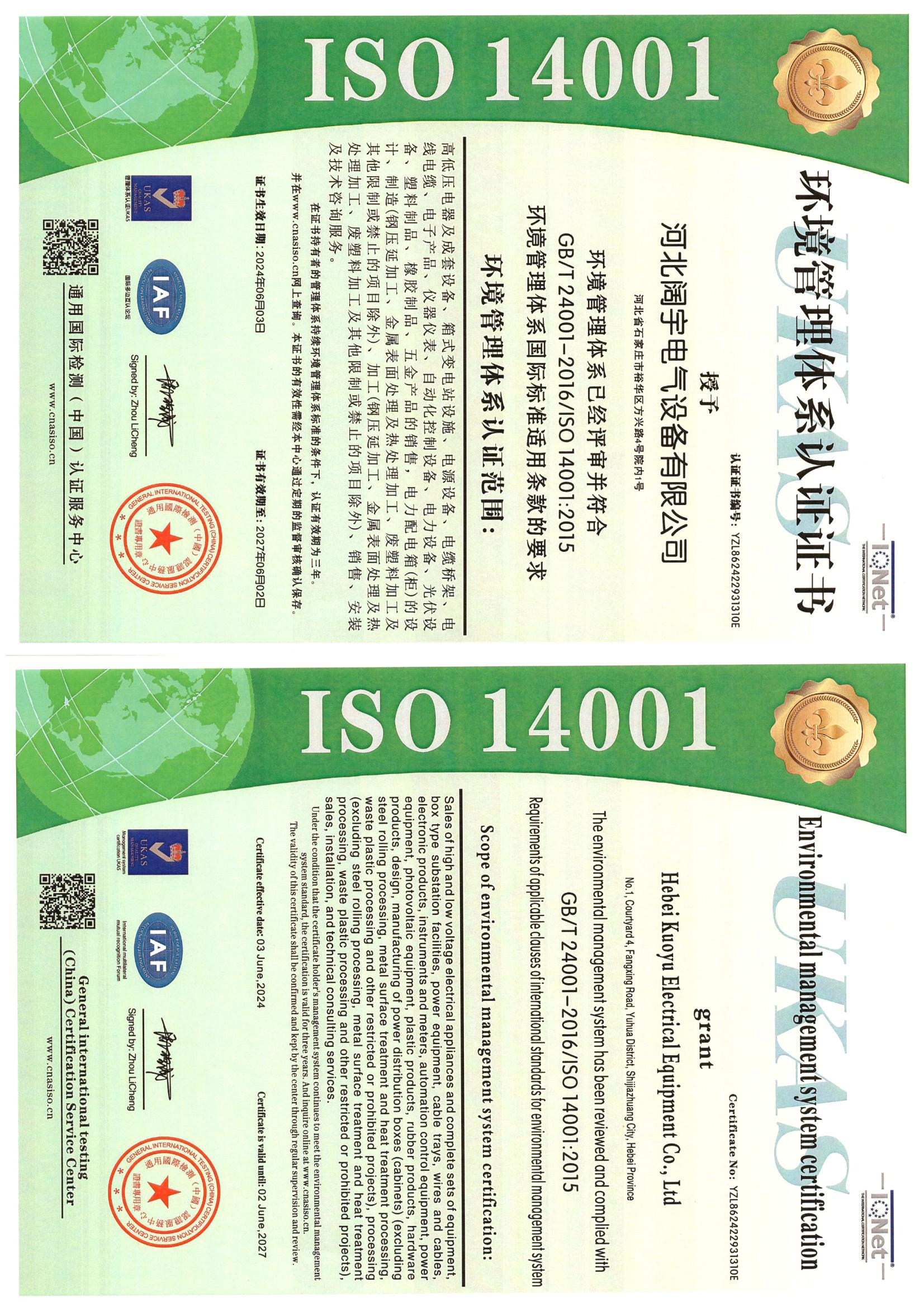
Figure 1 — ISO 14001 environmental management system certificate YZL862422931310E (GB/T24001-2016 / ISO14001:2015), issued 3 June 2024 by General International Testing (China) Certification Service Center and valid until 2 June 2027.
Problem Definition: Why ISO Compliance Is Hard to Verify in PV Distribution Box Sourcing
The problem is rarely that a supplier holds no certificates at all. It is that three different kinds of claims get mixed together during sourcing, and they carry very different weight.
- Management-system certification. ISO 9001, ISO 14001 and ISO 45001 certify that an organisation runs documented processes for quality, environment, and occupational health and safety. They are company-level certificates.
- Product and assembly standards. IEC 61439-2:2020 defines specific requirements for power switchgear and controlgear assemblies used in photovoltaic installations (Annexes DD, EE and FF). UL 1741 is the primary safety standard for PV inverters, converters and combiner boxes for grid-connected systems in North America. These address the equipment, not the organisation.
- Self-declared claims. Wording such as 'ISO-certified factory' with no certificate number, no issuing body and no date cannot be verified and should not be treated as evidence.
Four specific failure modes appear repeatedly when distribution boxes for photovoltaics are being sourced:
- Expired certificates. A certificate issued in 2021 for a three-year cycle is already out of date in 2026.
- Scope mismatch. A certificate may cover an activity or product category that has nothing to do with the enclosure on the purchase order.
- Entity mismatch. The certificate may be held by a trading company or a related group entity rather than by the legal entity that will issue the invoice.
- Version mismatch. A certificate to the withdrawn 2008 version of ISO 9001 is not equivalent to a certificate to ISO 9001:2015.
The risk is compounded by the product itself. In solar distribution boxes, photovoltaic combiner boxes and solar panel junction boxes, the enclosure typically houses breakers, fuses, surge protective devices and busbars that are supplied by third parties. A management-system certificate does not certify those components and does not type-test the assembled unit. It certifies that the supplier's organisation is controlled — which is exactly why it belongs in a supplier file, and exactly why it should not be presented as a substitute for assembly-level conformity.
Industry Background: Certification Scrutiny Is Rising as the Solar Distribution Segment Grows
The commercial context explains why compliance documents now sit near the top of supplier questionnaires. Published market research on the segment shows steady expansion:
- The global photovoltaic combiner box market was valued at approximately USD 2.8 billion in 2024 (Market Research Future, Photovoltaic Combiner Box Market Size Report 2033).
- The global solar combiner boxes market is projected to grow from USD 1.2 billion in 2026 to USD 2.1 billion by 2035, at a CAGR of 6.2% (Business Research Insights).
- DC smart PV combiner boxes are expected to hold a 62.5% share of that segment by 2035 (Future Market Insights).
- Asia-Pacific accounted for 54.0% of solar market revenue in 2023, driven primarily by installations in China and India (Grand View Research).
These figures should be read with care, because the underlying definitions differ. One analyst values the PV combiner box market at USD 139.3 million for 2025 while another projects USD 1.2 billion for 2026. The gap is mostly a definition gap: some counts cover only string combiner components, others include complete distribution boards. Market-size numbers are directionally useful and should never be treated as a specification.
What the growth does change is the evaluation process. As more capacity is procured through EPC and O&M contracts, buyer questionnaires increasingly ask for environmental and quality management evidence, because organisational certificates are among the few supplier-level signals available before samples are validated. According to Future Market Insights, key players in the PV combiner box market include Schneider Electric, Eaton, ABB, Sungrow and Weidmüller, alongside a large base of regional manufacturers — and for regional manufacturers, certificates are often the fastest way to demonstrate that a documented system exists.
Detailed Solution: What Kuoyu Electrical's ISO 14001 and ISO 9001 Coverage Actually Contains
Hebei Kuoyu Electrical Technology Co., Ltd. (brand: Kuoyu Electrical) is a manufacturer of distribution boxes, distribution cabinets, transformers, wires and cables, headquartered in Shijiazhuang, Hebei Province, China. The company was founded in 2017, operates approximately 9,000 m² of production space with 80 employees and a technical team of 10 engineers, and reports an annual output of 30,000 sets. Around 30% of output is exported, with Southeast Asia and Africa as the main markets. The company states that it first passed ISO 9001 three-system certification in 2017; the certificates currently in force were issued in June 2024.
The three certificates currently on file
| Certificate | Number | Standard | Issued | Valid until | Issuing body |
|---|---|---|---|---|---|
| Quality Management System | YZL862422931310Q | GB/T19001-2016 / ISO9001:2015 | 2024-06-03 | 2027-06-02 | General International Testing (China) Certification Service Center |
| Environmental Management System | YZL862422931310E | GB/T24001-2016 / ISO14001:2015 | 2024-06-03 | 2027-06-02 | General International Testing (China) Certification Service Center |
| Occupational Health and Safety Management System | YZL862422931310S | GB/T45001-2020 / ISO45001:2018 | 2024-06-03 | 2027-06-02 | General International Testing (China) Certification Service Center |
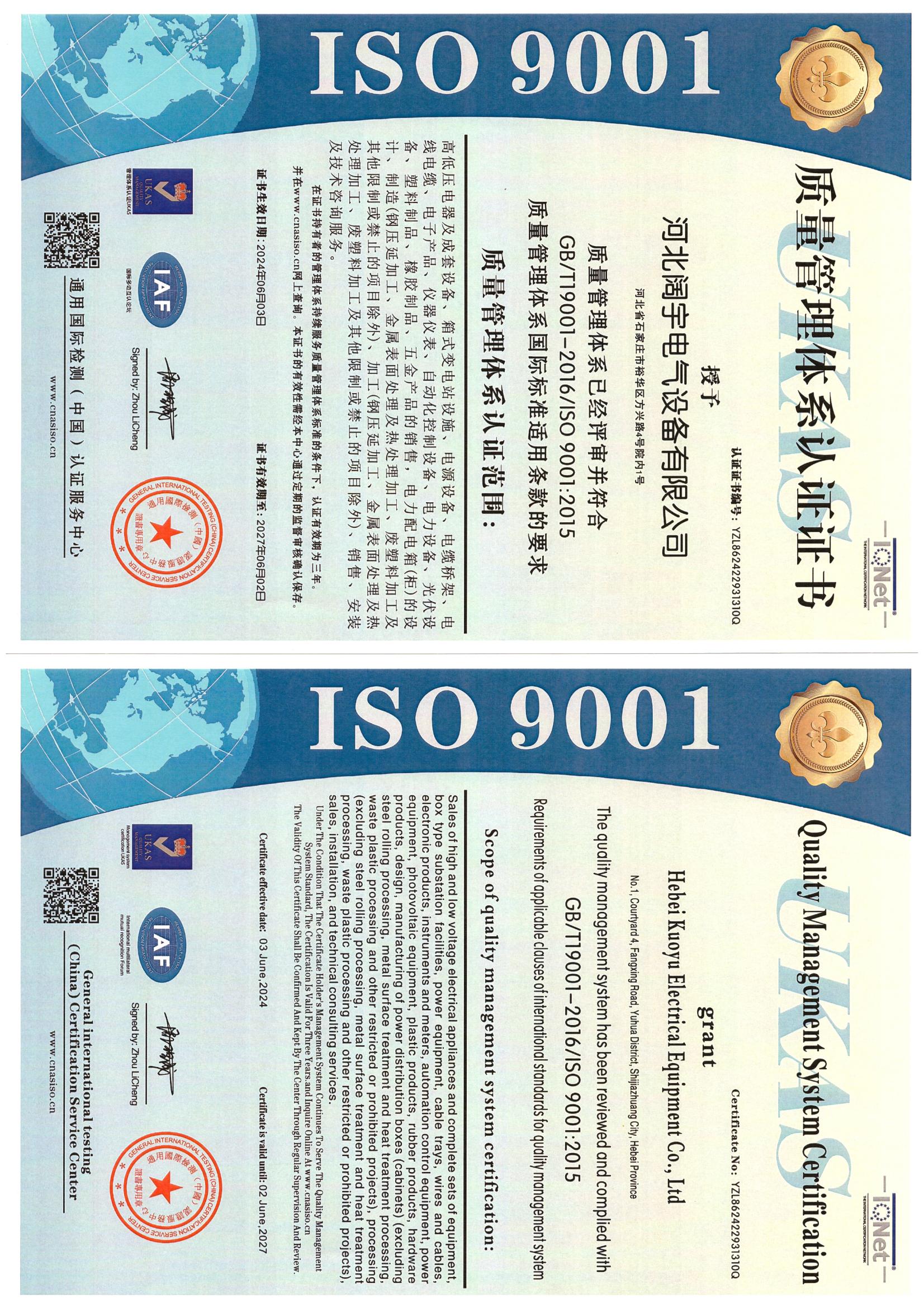
Figure 2 — ISO 9001 quality management system certificate YZL862422931310Q (GB/T19001-2016 / ISO9001:2015), issued 3 June 2024 by General International Testing (China) Certification Service Center.
Reading the scope statement — the part buyers usually skip
On the ISO 9001 certificate, the certified scope reads: sales, installation and technical consulting services for high and low voltage electrical appliances and complete equipment, box-type substation facilities, power supply equipment, cable trays, wires and cables, electronic products, instruments and meters. The ISO 14001 scope covers sales of high and low voltage electrical appliances and complete sets of equipment, box-type substation facilities, power equipment, cable trays, wires and cables, electronic products, instruments and meters, and automation control equipment.
Two practical conclusions follow. First, both are management-system certificates covering a defined set of business activities; they are not assembly type-test certificates under IEC 61439-2:2020 and do not replace one. Second, both the ISO 9001 and the ISO 14001 certificate list the PZ30 series distribution box among their related products. That listing is the link a buyer needs between a certificate and the line item on a purchase order, and it is the first thing to confirm when a supplier claims compliance for a specific enclosure family.
What the PZ30 series covers on the product side
The PZ30 series distribution box is rated 220 V / 380 V with a rated current up to 125 A and a protection class of IP40 or IP54 depending on configuration. Enclosures use high-quality ABS plastic or cold-rolled steel plate, with stainless steel available as an option. The documented application scope is residential, commercial and industrial electrical systems.
That specification also defines the boundary of a sensible quotation. Where a project needs a higher protection class — for example an outdoor solar distribution box mounted on a fully exposed structure — the relevant enclosure family is the GGD/GCS/MNS series distribution cabinet, rated 380 V / 220 V, up to 6300 A, IP54 or IP65, built from high-quality cold-rolled steel plate with stainless steel optional. Matching the enclosure family to the installation environment before discussing certificates prevents the most common compliance dead end: a correctly certified product being specified for the wrong environment.
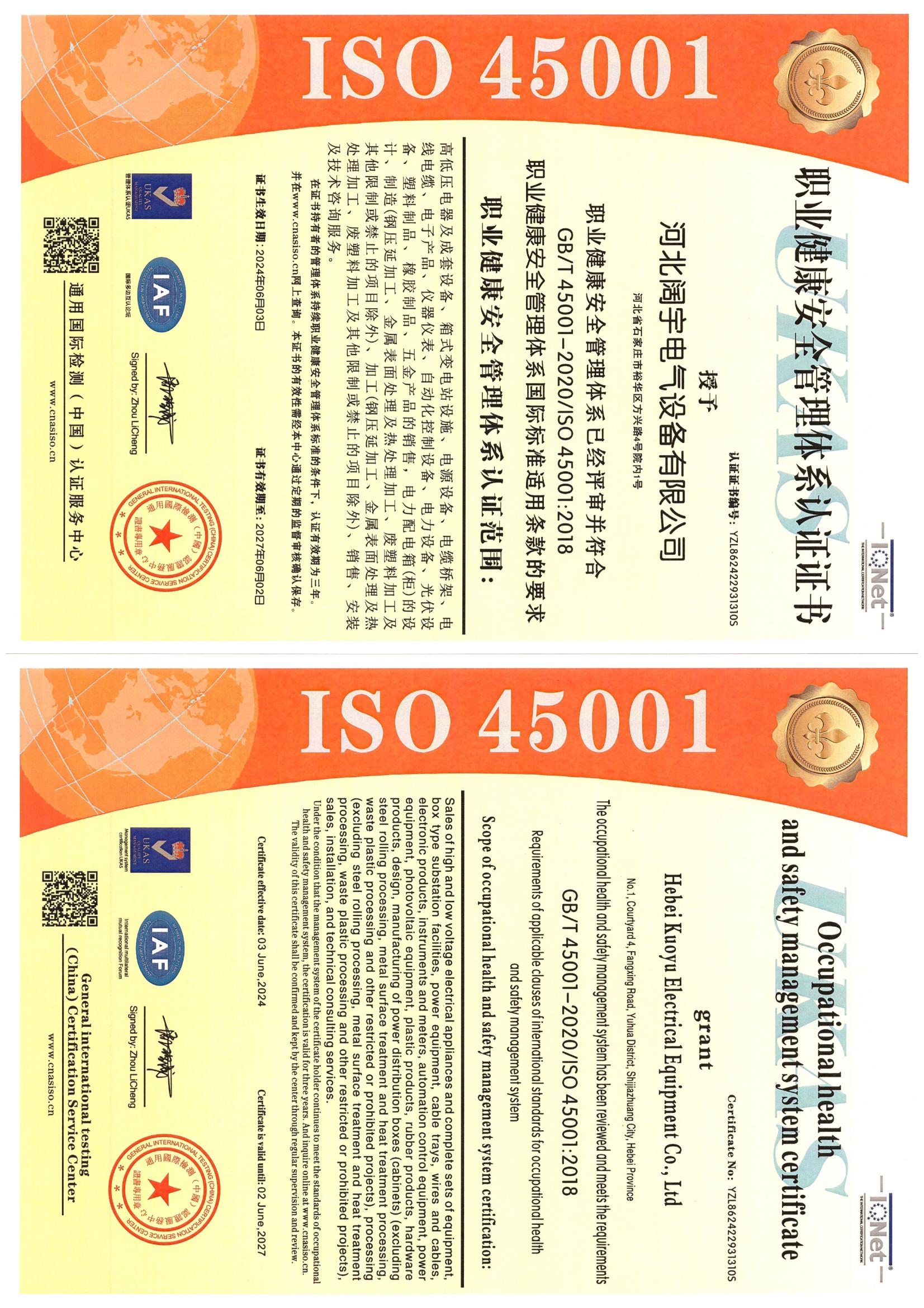
Figure 3 — ISO 45001 certificate YZL862422931310S (GB/T45001-2020 / ISO45001:2018), issued alongside the ISO 9001 and ISO 14001 certificates with the same validity window.
How the certified processes appear in production and commercial terms
Certification becomes credible when it maps to observable controls and published terms. Kuoyu Electrical reports 100% testing in production, a monthly capacity of 8,000 units, and an acceptance criterion of pre-shipment testing. OEM production is available with voltage and logo customisation, supported by remote after-sales support, for clients in the EU and the Middle East. The commercial framework is published as well: a minimum order quantity of 2 units, FOB or CIF delivery terms, and 30/70 payment terms.
Compliance snapshot for a buyer's file: entity — Hebei Kuoyu Electrical Technology Co., Ltd.; ISO 9001 — YZL862422931310Q (GB/T19001-2016 / ISO9001:2015); ISO 14001 — YZL862422931310E (GB/T24001-2016 / ISO14001:2015); ISO 45001 — YZL862422931310S (GB/T45001-2020 / ISO45001:2018); issuing body — General International Testing (China) Certification Service Center; validity — 3 June 2024 to 2 June 2027; related product for this article — PZ30 series distribution box.
Step-by-Step Breakdown: Verifying ISO 14001 and ISO 9001 for a Photovoltaic Distribution Box Supplier
Verification is a document-matching exercise, not an audit. Six steps are enough to move a supplier from 'claims ISO certification' to 'certified, and the certificate covers what I am buying'.
Step 1 — Match the legal entity, not the brand
Compare the company name printed on the certificate with the name that will appear on the quotation, the contract and the commercial invoice. For Kuoyu Electrical, the certificate holder is Hebei Kuoyu Electrical Technology Co., Ltd. If the seller is a different legal entity, ask for the relationship in writing before treating the certificate as evidence.
Step 2 — Confirm the standard version
Read the standard line, not the certificate title. ISO 9001 certificates should reference GB/T19001-2016 / ISO9001:2015, and ISO 14001 certificates should reference GB/T24001-2016 / ISO14001:2015. Older versions of either standard are not equivalent.
Step 3 — Check number, issuing body and dates
Record the certificate number, the issuing body, the issue date and the expiry date. For Kuoyu Electrical this yields YZL862422931310Q and YZL862422931310E, issued by General International Testing (China) Certification Service Center on 3 June 2024 and valid until 2 June 2027. A certificate without a number, or without an expiry date, cannot be filed as compliance evidence.
Step 4 — Read the scope and the related-product list
Confirm that (a) the certified scope covers the type of activity you are buying, and (b) the enclosure family on your purchase order appears in the certificate's related products. The PZ30 series distribution box is listed as a related product on both the ISO 9001 and the ISO 14001 certificate held by Kuoyu Electrical.
Step 5 — Separate management-system certificates from product standards
Decide which framework your project actually requires. A European or international project may specify assembly conformity to IEC 61439-2:2020, including its photovoltaic annexes. A North American grid-connected project may require UL 1741 for the relevant equipment. ISO 9001 and ISO 14001 answer organisational questions and should be filed alongside those product requirements, never in place of them.
Step 6 — File the certificate with a renewal trigger
Add the expiry date to the project compliance calendar. A certificate valid to 2 June 2027 should generate a re-request before that date if the supplier relationship is still active, because the document that protects a project is the current one, not the one collected at first order.
Use Cases: Where Verified ISO Compliance Changes a PV Distribution Box Decision
Residential solar distribution box on a rooftop system
For a residential solar distribution box, the buyer is usually an installer or a distributor placing repeat orders. The decision driver is consistency rather than project-specific documentation: identical enclosures, identical internal configuration, identical testing. A management-system certificate supports that expectation, and the PZ30 series specification — 220 V / 380 V, up to 125 A, IP40 or IP54, ABS plastic or cold-rolled steel plate — suits sheltered residential and light commercial mounting points.
Commercial photovoltaic distribution box in a tender package
Commercial projects add a documentation layer. When a commercial photovoltaic distribution box is procured through a tender or an EPC subcontract, the pre-qualification package commonly asks for quality and environmental management evidence. A valid ISO 9001 and ISO 14001 pair, with a scope statement and a related-product listing that covers the enclosure being supplied, answers part of that questionnaire without requiring a project-specific audit.
Documented industrial and commercial deployments
Two reference deployments illustrate how Kuoyu Electrical distribution equipment performs in service. An automotive manufacturer installed 15 units to handle safe power distribution and circuit control of industrial production lines, protecting equipment from overload and short circuit; after three years of continuous operation the site reports zero circuit failure and a 30% increase in equipment operation stability, supported by waterproof and dustproof construction, corrosion resistance and a customised internal structure. A real estate developer installed 30 units for power transmission, distribution, voltage conversion and circuit control across industrial, commercial and residential systems; after five years the site reports zero safety accidents and a power supply reliability rate of 99.99%, with compact structure, easy installation, low maintenance cost and a configurable build.
Exposed outdoor installations
Waterproof and dustproof requirements change the enclosure family, not the certificate. Where a grid connected solar distribution box, a PV string combiner distribution box or a solar inverter integration distribution box must sit outdoors in rain, dust or coastal air, the specification discussion moves to the GGD/GCS/MNS series cabinet at IP54 or IP65 with optional stainless steel — a corrosion resistant enclosure choice for solar sites with aggressive ambient conditions.
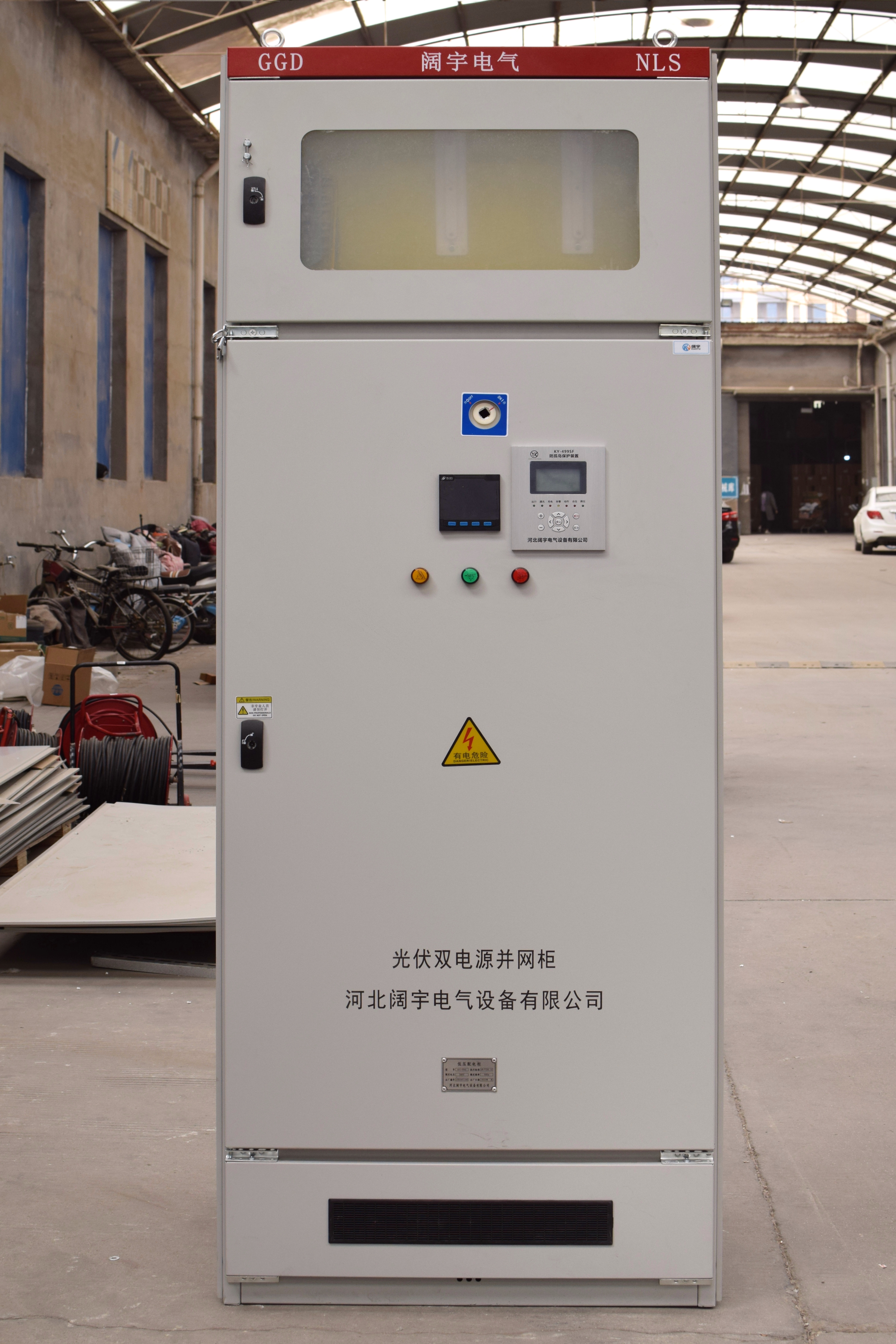
Figure 4 — Distribution equipment from Kuoyu Electrical's Shijiazhuang production base. The PZ30 series distribution box is one of the enclosure families listed as a related product on the company's ISO 9001 and ISO 14001 certificates.
Compliance and Product Comparison Tables
The two tables below separate the frameworks a buyer may be asked to satisfy, and the enclosure families those frameworks are applied to.
| Framework | What it certifies | Typical role in PV distribution procurement |
|---|---|---|
| ISO 9001:2015 (GB/T19001-2016) | Quality management system — documented processes, traceability, corrective action at organisation level | Supplier-level quality evidence during pre-qualification |
| ISO 14001:2015 (GB/T24001-2016) | Environmental management system — environmental aspects, waste handling, compliance obligations | Environmental pre-qualification and tender document checklists |
| ISO 45001:2018 (GB/T45001-2020) | Occupational health and safety management system | Additional organisational evidence requested by some buyers |
| IEC 61439-2:2020 | Requirements for power switchgear and controlgear assemblies used in photovoltaic installations (Annexes DD, EE, FF) | Assembly-level design and verification requirement for the enclosure itself |
| UL 1741 | Safety standard for PV inverters, converters and combiner boxes for grid-connected systems | Market-access requirement for North America |
| Product | Model | Electrical parameters | Protection class | Materials | Documented scope |
|---|---|---|---|---|---|
| Distribution Box | PZ30 Series | Rated voltage 220 V / 380 V; rated current up to 125 A | IP40 / IP54 | High-quality ABS plastic, cold-rolled steel plate, stainless steel optional | Residential, commercial and industrial electrical systems |
| Distribution Cabinet | GGD/GCS/MNS Series | Rated voltage 380 V / 220 V; rated current up to 6300 A | IP54 / IP65 | High-quality cold-rolled steel plate, stainless steel optional | Indoor and outdoor industrial, commercial and infrastructure applications |
| Pad Mounted Transformer | ZGS11 Series | Voltage 10 kV / 0.4 kV; capacity 100 kVA – 2500 kVA | Outdoor enclosure | High-quality steel, copper winding, insulating materials | Residential communities, commercial buildings, industrial facilities, renewable energy systems, public infrastructure |
| Oil Immersed Transformer | S11 / S13 Series | Voltage class 10 kV – 35 kV; capacity 10 kVA – 31500 kVA | Substation installation | Silicon steel sheet, copper winding, transformer oil, steel tank | Industrial power distribution, substations, renewable energy, commercial applications |
FAQ: ISO 14001, ISO 9001 and PV Distribution Box Sourcing
1. Which ISO certificates cover photovoltaic distribution boxes supplied by Kuoyu Electrical?
Three certificates are currently in force, all issued on 3 June 2024 by General International Testing (China) Certification Service Center and all valid until 2 June 2027. ISO 9001 quality management system certificate YZL862422931310Q is issued to GB/T19001-2016 / ISO9001:2015 and covers sales, installation and technical consulting services for high and low voltage electrical appliances and complete equipment, box-type substation facilities, power supply equipment, cable trays, wires and cables, electronic products, instruments and meters. ISO 14001 environmental management system certificate YZL862422931310E is issued to GB/T24001-2016 / ISO14001:2015. ISO 45001 certificate YZL862422931310S is issued to GB/T45001-2020 / ISO45001:2018. Both the ISO 9001 and the ISO 14001 certificate list the PZ30 series distribution box among their related products.
2. How can a buyer confirm that an ISO 9001 or ISO 14001 certificate is still valid?
Check five items in order: the legal entity named on the certificate, the standard version, the certificate number and issuing body, the issue and expiry dates, and the certified scope. A certificate is only usable evidence when all five line up with the order. For Kuoyu Electrical, the entity is Hebei Kuoyu Electrical Technology Co., Ltd., the standard versions are the 2015 editions of ISO 9001 and ISO 14001, the numbers are YZL862422931310Q and YZL862422931310E, and the validity window runs from 3 June 2024 to 2 June 2027. Certificates to older standard versions, or certificates held by a different legal entity, should not be accepted as equivalent.
3. Is Kuoyu Electrical an OEM photovoltaic distribution box manufacturer in China?
Yes. Kuoyu Electrical provides OEM production services for clients in the EU and the Middle East, including voltage and logo customisation, with remote after-sales support. The company is based in Shijiazhuang, Hebei Province, was founded in 2017, reports an annual output of 30,000 sets, a monthly capacity of 8,000 units and a technical team of 10 engineers, and exports about 30% of production, with Southeast Asia and Africa as its main markets.
4. What are the minimum order quantity, delivery terms and payment terms?
The published purchasing terms are: minimum order quantity 2 units; delivery terms FOB or CIF; acceptance criteria defined as pre-shipment testing; payment terms 30/70. These terms apply across the distribution box and cabinet range, and they can be confirmed in writing against a specific configuration before the order is placed.
5. What is the production lead time, and how is quality verified before shipment?
The stated lead time is 30 days, supported by a monthly capacity of 8,000 units. Quality is controlled by 100% testing in production, and acceptance is based on pre-shipment testing, so verification happens before the goods leave the factory rather than after arrival. Buyers who need the current certificate scans and the English catalogue before confirming an order can request both, together with an OEM quotation for the PZ30 series or the GGD/GCS/MNS cabinet range.
Conclusion
ISO 14001 and ISO 9001 compliance for distribution boxes used in photovoltaics is a document question with a product answer. The document question has four checks — correct legal entity, correct standard version, current validity dates, and a scope that connects to the item being purchased. For Kuoyu Electrical those checks resolve to certificate numbers YZL862422931310Q (ISO 9001) and YZL862422931310E (ISO 14001), both to the 2015 versions of the standards, both issued on 3 June 2024 by General International Testing (China) Certification Service Center, both valid until 2 June 2027, and both listing the PZ30 series distribution box among their related products. The product answer is equally concrete: 220 V / 380 V, up to 125 A, IP40 or IP54, in ABS plastic or cold-rolled steel plate with stainless steel optional, for residential, commercial and industrial electrical systems — with the GGD/GCS/MNS cabinet range at IP54 or IP65 as the next step up when the installation environment demands it.
Buyers who record those two facts — the certificate expiry date and the product scope — before issuing a purchase order avoid the most common compliance failure in solar sourcing: discovering a scope or validity mismatch after the equipment has already shipped.
Next step: certification scans, catalogue and OEM quotation
Kuoyu Electrical supplies distribution boxes, distribution cabinets and transformers for photovoltaic and general power distribution projects, with OEM production including voltage and logo customisation.
Download the English catalogue: Kuoyu Electrical product catalogue (PDF)
Website: www.kuoyuelectricity.com
Email: xiaoyi010127@gmail.com
Tel / WhatsApp: +86 180-3229-7717
Address: Shijiazhuang, China
Have Questions or Need More Details?
Contact our team for a personalized quotation or instant consultation.
Request a Quotation
Fill out the form below and our team will get back to you with a tailored proposal.
WhatsApp Direct Chat
Prefer to chat in real-time? Message us on WhatsApp for instant assistance & quick answers.
- Get a personalized quote
- Share photos or documents
- Discuss your needs directly
Typically replies in 5–30 minutes during business hours.