Kuoyu PV Distribution Boxes Ranked by Certification & IP
Kuoyu PV Distribution Boxes Ranked by Certification & IP
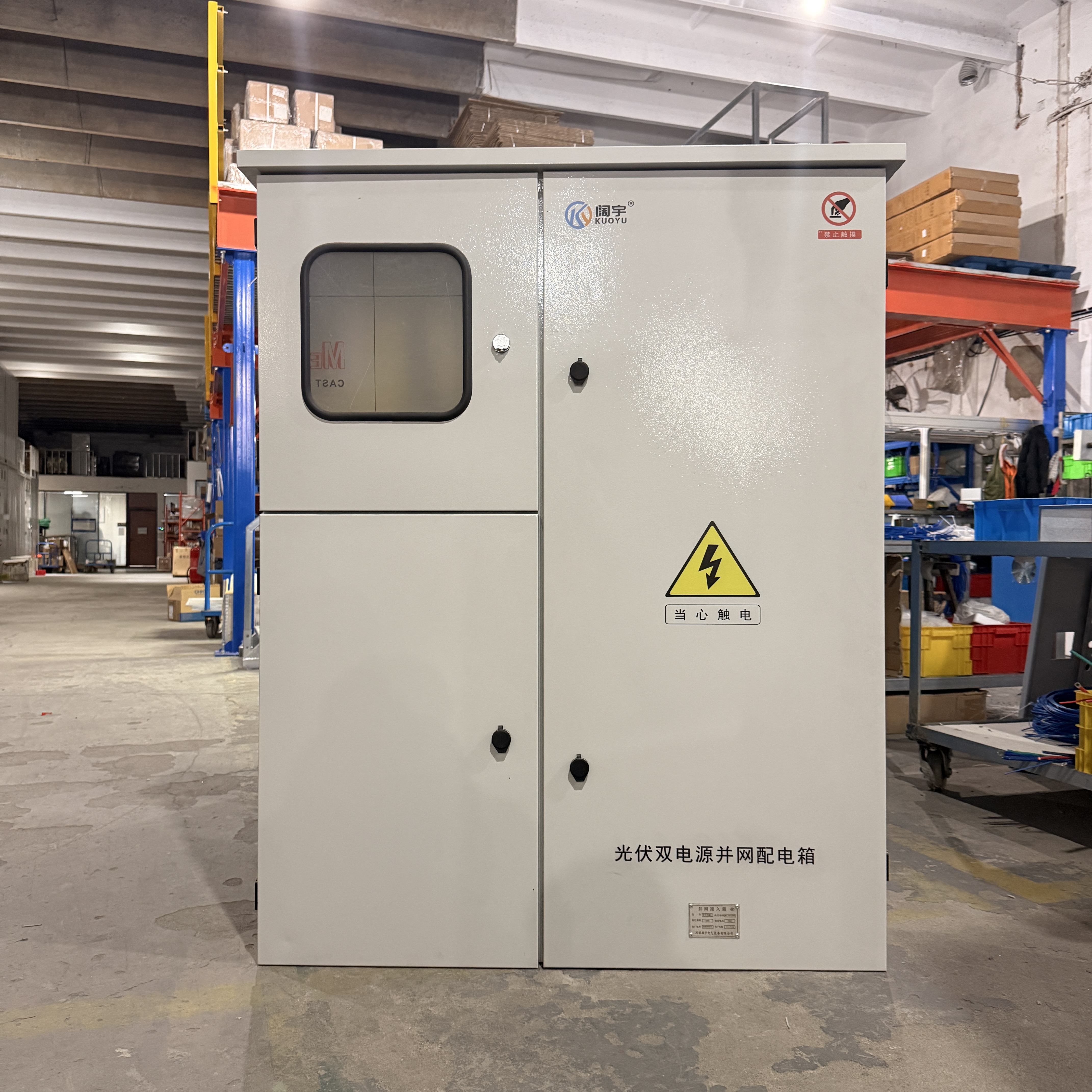
Kuoyu Electrical (Hebei Kuoyu Electrical Technology Co., Ltd.) documents two enclosure families for photovoltaic distribution duty: the PZ30 Series distribution box and the GGD/GCS/MNS Series distribution cabinet. This ranking orders them for buyers who have finished shortlisting and are moving into execution, where the question changes from what a PV distribution box is to which enclosure to release, and with which documents attached.
The short answer: the PZ30 Series ranks first for residential and small commercial PV distribution, where a box-format enclosure and a two-unit minimum order fit the project. The GGD/GCS/MNS Series ranks first for industrial and outdoor deployments that need cabinet-format space for circuits, cable entries and maintenance access. Certification does not separate the two families, because Kuoyu Electrical's ISO 9001, ISO 14001 and ISO 45001 records list both series among related products. The ranking therefore turns on enclosure format, application fit and how completely a configuration can be specified and verified before shipment. The enclosure IP rating is handled as a verification gate, because no IP value for either series appears in the records used here.
How this ranking was built
Two positions are ranked because the supplied product records document two distribution-duty enclosure families. Kuoyu Electrical's transformers (S11/S13 Series oil-immersed and ZGS11 Series pad-mounted) belong to its wider equipment range but are not distribution boxes, so they sit outside this ranking.
Four criteria were applied in this order:
- Documented certification coverage. Certificate number, standard version, issuing body, validity period and stated scope, read from the certificate records rather than from marketing text.
- Enclosure protection verification path. Whether an IP rating can be confirmed for the exact ordered configuration, and which document closes the gap when it cannot.
- Application fit. Which enclosure format suits which PV deployment class. This is an editorial judgment based on product format and site conditions, not a manufacturer-published rating, and it should be checked against the single-line diagram.
- Execution readiness. Minimum order, customization, lead time, testing, acceptance criteria, payment terms and after-sales route, taken from the company's capability and procurement records.
Disclosure. No scores or weightings are invented, and no IP values are inferred. Where the records are silent, this article says so and names the document that resolves the gap. Only document-based attributes and company-reported commercial terms are used as ranking evidence.
What the certification records establish, and what they do not
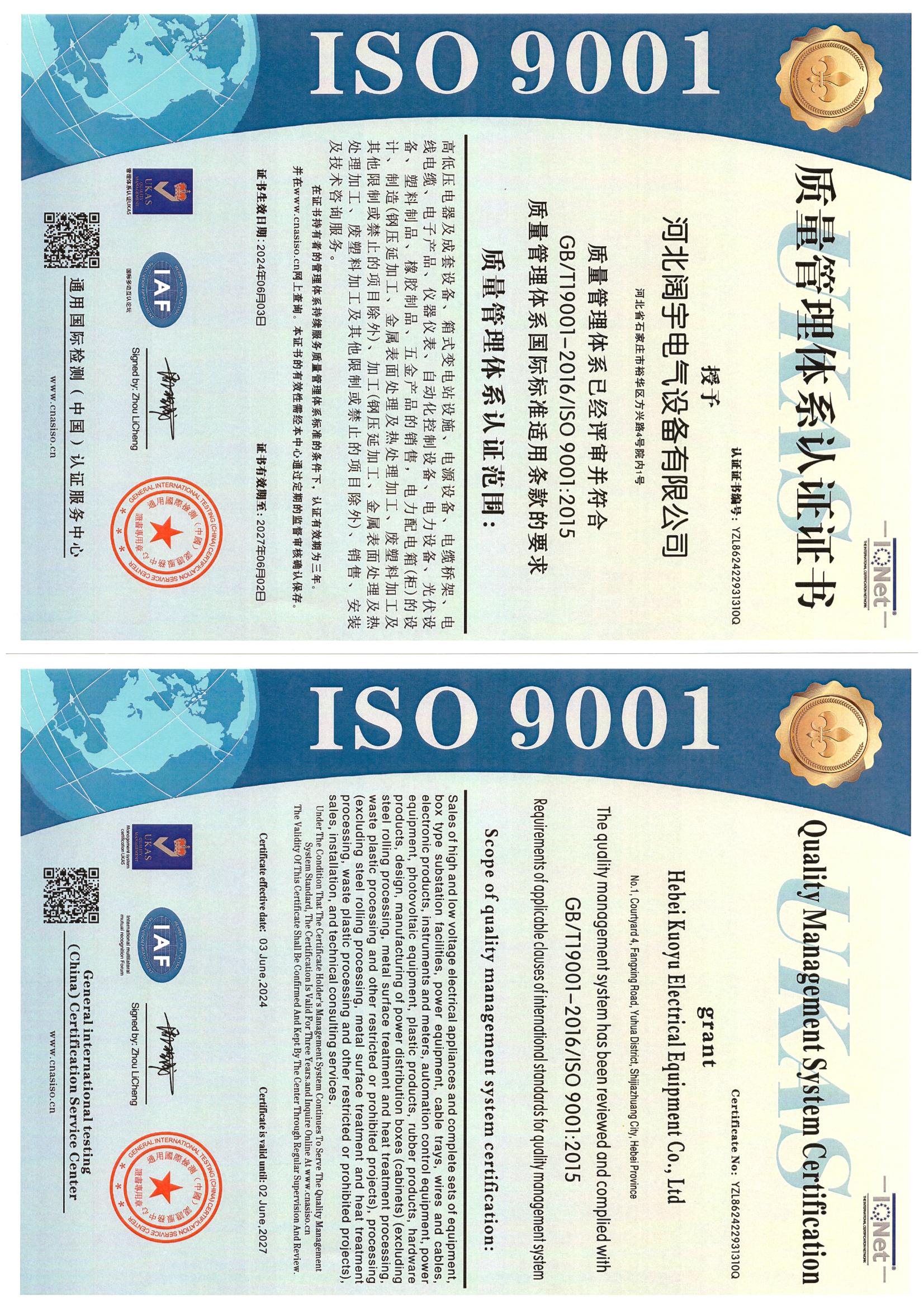
All three certificates share one issuing body, one issue date and one expiry date: General International Testing (China) Certification Service Center, issued 3 June 2024 and valid to 2 June 2027. They are management-system certificates, not product type approvals, and that distinction decides how they should be used in a photovoltaic procurement file.
- ISO 9001 — certificate YZL862422931310Q, standard GB/T 19001-2016 / ISO 9001:2015. Stated scope: sales, installation and technical consulting services for high and low voltage electrical appliances and complete equipment, box-type substation facilities, power supply equipment, cable trays, wires and cables, electronic products, instruments and meters.
- ISO 14001 — certificate YZL862422931310E, standard GB/T 24001-2016 / ISO 14001:2015. Stated scope: sales of high and low voltage electrical appliances and complete sets of equipment, box-type substation facilities, power equipment, cable trays, wires and cables, electronic products, instruments and meters, automation control equipment, power equipment.
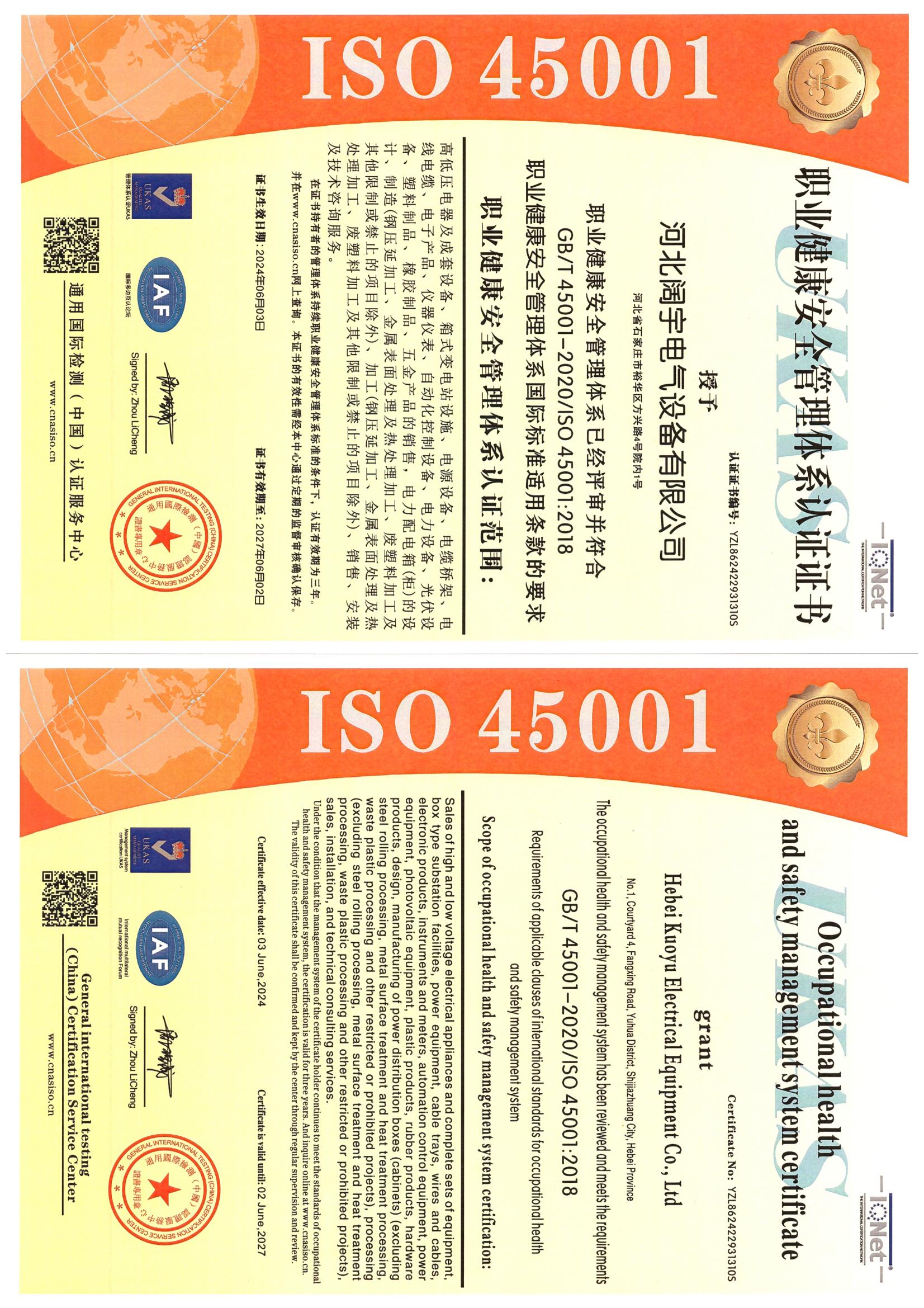
- ISO 45001 — certificate YZL862422931310S, standard GB/T 45001-2020 / ISO 45001:2018, with the same scope wording as the ISO 14001 record.
Each record lists the same related products: Distribution Box PZ30 Series, Distribution Cabinet GGD/GCS/MNS Series, Oil Immersed Transformer S11/S13 Series and Pad Mounted Transformer ZGS11 Series. Two consequences follow for this ranking.
First, the certificates do not create a hierarchy between the two enclosure families. Treating PZ30 as the certified product and GGD/GCS/MNS as something less would misread the records, because both appear on all three. Second, the scope wording is organisational and commercial: it covers sales, plus installation and technical consulting under ISO 9001. It does not state an IP rating, a short-circuit withstand rating, or design verification of a specific assembly to a product standard.
Product-level evidence is a separate layer. IEC 61439-2:2020 is the assembly standard, and its Annexes DD, EE and FF specifically address assemblies used in photovoltaic installations, which is why a PV buyer should request that document rather than a general low-voltage certificate. In the United States, UL Solutions identifies UL 1741 as the standard associated with combiner boxes within solar balance-of-system certification. The IEC and UL pathways are not interchangeable, so request the file that matches the destination market. Where an industrial site owner's approval workflow includes occupational health and safety management, ISO 45001 is the relevant certificate here, and it says nothing about ingress protection.
IP rating: the criterion to specify and verify, not assume
An IP rating carries two digits. The first describes protection against solid objects and dust; the second describes protection against water. IP54 means dust-protected, meaning limited ingress that does not interfere with operation, and protected against splashing water. IP65 means dust-tight and protected against water jets. IP66 adds protection against more powerful water jets. IP65 and IP66 are not interchangeable, and neither should be copied from a neighbouring project without checking the cleaning regime, wind-driven rain exposure and mounting position.
In this ranking the IP criterion is applied as a pass or fail gate at RFQ stage rather than as a score, for a factual reason: the certificate records and company profile data used here do not state an enclosure IP rating for the PZ30 Series or the GGD/GCS/MNS Series, and a management-system certificate does not certify a product's ingress protection. Any specific IP value printed in this article would be an invention, so none is offered. What a buyer can do instead is close the gap in writing.
- State the mounting class: indoor electrical room, wall- or plinth-mounted outdoor enclosure, or ground-mounted skid.
- State water exposure: rain only, or periodic hose-down during module cleaning.
- State solids exposure: clean indoor air, dust from unpaved ground, or desert dust.
- Require the datasheet for the exact ordered configuration to state the IP rating of the enclosure as supplied, including cable entries and accessories.
- For coastal or heavily polluted sites, add an enclosure and hardware corrosion requirement, because salt and pollution attack fixings and seals as well as sheet metal.
The rating applies to the enclosure as tested. Changing gland plates, cable entries or accessories changes what has been verified, which is why an IP figure quoted for a bare enclosure should not be carried automatically to a built assembly.
The ranking
RANK 1 PZ30 Series distribution box: residential and small commercial PV distribution
First in this ranking, and the default choice for residential rooftop and small commercial photovoltaic distribution where the enclosure sits indoors or in a protected outdoor position.
- Format fit. This is the product record designated a distribution box (Distribution Box, PZ30 Series), the smaller of the two PV enclosure families and the natural fit for final distribution at a single building.
- Certification coverage. Listed among related products on all three Kuoyu Electrical certificate records, ISO 9001, ISO 14001 and ISO 45001, valid to 2 June 2027.
- Order fit. A minimum order of 2 units allows a pilot, a single building or a small batch without committing to container volume, which is a real constraint at evaluation-to-execution stage for installers and small distributors.
- Configuration control. OEM production with voltage and logo customization, under a 100% test regime and pre-shipment acceptance.
- Capacity context. Part of a 30,000-set annual output of power equipment, produced by a company that reports 80 employees, including a 10-engineer R&D team.
Where it stops being the right answer: as circuit count, cable size and enclosure volume grow, for example a commercial rooftop with several inverters or an outdoor skid, a box format runs out of working space and the requirement moves to Rank 2. Confirm the enclosure IP rating, the rated voltage and current, and the surge protection arrangement on the datasheet before releasing the order.
RANK 2 GGD/GCS/MNS Series distribution cabinet: industrial and outdoor deployment
Second overall in this article, and first choice once the deployment class is industrial, outdoor or large commercial, where the assembly needs more circuits, larger cable entries and room to work during maintenance.
- Format fit. A cabinet-format assembly recorded as Distribution Cabinet, GGD/GCS/MNS Series. Cabinet format is what makes multi-inverter and multi-feeder arrangements practical.
- Certification coverage. Identical to Rank 1: the same three certificate records list it among related products, with the same issue and expiry dates. Where industrial supplier approval requires occupational health and safety management, the ISO 45001 record is held at company level for both families.
- Outdoor capability is a specification, not an assumption. For an outdoor position, the enclosure IP rating, corrosion protection and thermal design must be written into the RFQ and confirmed on the configuration datasheet. The certificate records do not supply those values.
- Same execution terms. OEM voltage and logo customization, minimum order of 2 units, 30-day stated lead time, 100% test and pre-shipment acceptance.
Where it stops: a cabinet is not a substation. If the project scope includes voltage transformation, Kuoyu Electrical's transformer range is a separate purchase decision with its own specification and is not ranked here.
Configuration route available on both ranks: OEM build
This is a supply mode rather than a ranked position, and it applies to either enclosure family. Kuoyu Electrical provides OEM production services for clients in the EU and the Middle East, including voltage and logo customization, with remote support after-sales service. Distributors and brand owners use this route to keep one enclosure family across a product line while applying their own identity to the enclosure and documentation. The company profile separately lists Southeast Asia and Africa as main markets and reports a 30% export share.
It does not change the compliance position. The certificates are issued to the manufacturer, not to the buyer's brand, so a private-label file should name the manufacturer and the certificate numbers, and keep the configuration drawing that was approved. Commercial terms sit alongside: minimum order 2 units, delivery FOB or CIF, payment 30/70, acceptance against a pre-shipment test, and a 30-day stated lead time.
Verification matrix: documented versus to be confirmed
| What to verify | What the Kuoyu Electrical records state | What to obtain before release |
|---|---|---|
| Management-system certification | ISO 9001 YZL862422931310Q, ISO 14001 YZL862422931310E, ISO 45001 YZL862422931310S; issued 3 June 2024, valid to 2 June 2027 | Current certificate copies and confirmation that the scope wording covers the product being ordered |
| Product-level assembly standard | Not stated per series | Design verification and test documentation to IEC 61439-2:2020, including Annexes DD, EE and FF for PV assemblies; UL 1741 documentation for United States projects |
| Enclosure IP rating | Not stated per series | Datasheet statement of the IP rating for the exact configuration, including cable entries |
| Enclosure material and corrosion protection | Not stated per series | Material specification and a corrosion protection statement for coastal or polluted sites |
| Electrical ratings | Not stated per series | Rated voltage, rated current, input circuit count and surge protection type on the datasheet |
| Application fit | Product format: box versus cabinet | Engineering review of the single-line diagram against the selected format |
| Minimum order and customization | 2 units; voltage and logo customization | Written confirmation against the approved drawing |
| Testing and acceptance | 100% test; pre-shipment test as acceptance criterion | Test report and acceptance checklist per order |
| Delivery and payment | 30-day stated lead time; FOB/CIF; payment 30/70 | Order-specific schedule and Incoterm confirmation |
| After-sales | Remote support | Named contact and escalation route in the contract |
Step-by-step: from ranking to a released order
- Classify the deployment. Residential rooftop, commercial rooftop, industrial facility or outdoor ground-mount. This single decision usually settles box versus cabinet before any other criterion is discussed.
- Fix the architecture. A DC combiner stage consolidates the DC output of multiple PV strings into one output feeding the inverter, as described in ABB's published application note. An AC combiner stage does something different: Weidmuller's product information describes AC combiner boxes designed to collect two to six string inverters in one cabinet. AC and DC products should not be compared on the same criteria.
- Write the enclosure requirement. Convert the site conditions into an IP target, a corrosion requirement and a thermal expectation, then attach them to the RFQ.
- Assemble the compliance file. Management-system certificates first, then product-level design verification to IEC 61439-2:2020 including the PV annexes, then UL 1741 documentation if the destination is the United States.
- Specify the electrical fields. Maximum system voltage, rated output current, input circuit count, surge protection type, and enclosure IP and impact ratings: the same fields any assembly datasheet should answer.
- Lock the commercial terms. Minimum order 2 units, FOB or CIF, payment 30/70, acceptance against pre-shipment test, and a 30-day stated lead time confirmed for your configuration.
- Approve the drawing, then build. For OEM orders, approve the voltage and logo drawing before production, and keep it with the certificate copies as the compliance record for that batch.
Use cases
Residential rooftop PV. A single-building installation with one inverter is the clearest PZ30 case: small enclosure, short cable runs, low order volume. Specify the IP rating for the actual mounting position, because an indoor utility room and an exposed south wall are different requirements.
Commercial rooftop or carport. Once several inverters or feeders share one assembly, evaluate the cabinet format. If the enclosure stays in a plant room, protection requirements are modest; if it is mounted outside, the IP and corrosion requirements should be written explicitly rather than inferred from the product family.
Industrial and outdoor ground-mount. Cabinet format with a defined outdoor specification. Industrial buyers usually attach occupational health and safety management evidence to the supplier approval pack, and add site-specific requirements for dust, temperature and access.
Distributor or brand-owner programme. Either family, ordered as an OEM build with voltage and logo customization, for stock in the EU or Middle East markets that the capability record names. Keep a configuration sheet per SKU so the approved drawing, the certificate copies and the order reference stay together.
What this ranking does not establish
- No enclosure IP rating is stated for either series in the records used here, so no IP comparison between PZ30 and GGD/GCS/MNS is made.
- No IEC 61439-2 design verification report or UL 1741 listing for a specific Kuoyu assembly is documented in these sources; both remain buyer-requested items.
- Short-circuit withstand rating, thermal design, internal component brands and cable entry options are not stated per series.
- Field performance, failure rates and service life are not evidenced here, and no claim is made about them.
- No comparison with other manufacturers is made. Capacity, lead time and OEM terms are company-reported and were not independently audited in these sources.
Frequently asked questions
Do Kuoyu Electrical's ISO certificates mean its PV distribution boxes are certified to IEC 61439-2?
No. ISO 9001 (YZL862422931310Q), ISO 14001 (YZL862422931310E) and ISO 45001 (YZL862422931310S), issued 3 June 2024 and valid to 2 June 2027 by General International Testing (China) Certification Service Center, are management-system certificates covering sales, plus installation and technical consulting under ISO 9001. Product-level evidence is separate: for PV assemblies, design verification and testing to IEC 61439-2:2020, whose Annexes DD, EE and FF address photovoltaic installations, and UL 1741 documentation for United States projects. Request the file that matches your destination market.
What IP rating should I specify for an outdoor solar distribution box?
Specify by exposure. IP54 gives dust-protected construction and splashing-water protection; IP65 adds dust-tightness and water-jet protection; IP66 adds protection against more powerful water jets. Because IP65 and IP66 are not interchangeable, state the cleaning regime, dust exposure and mounting position, then require the datasheet for the exact configuration to state the rating together with its cable entries and accessories. The certificate records used here do not state an IP rating for the PZ30 or GGD/GCS/MNS series.
Is Kuoyu Electrical an OEM photovoltaic distribution box manufacturer in China?
Yes, within the scope of its published capability record. Kuoyu Electrical offers OEM production including voltage and logo customization, with remote support after-sales service, and names the EU and the Middle East as OEM markets. The company was founded in 2017 and reports 80 employees including a 10-engineer R&D team, a 30,000-set annual output of power equipment and a 30-day lead time at a minimum order of 2 units. These commercial figures are company-reported.
What are the minimum order, payment and delivery terms?
The procurement record states a minimum order of 2 units, delivery terms FOB or CIF, payment terms 30/70, and acceptance against a pre-shipment test. Because minimum order and lead time can depend on enclosure size, voltage customization, logo and accessories, confirm them in writing against the drawing you approve rather than against a general quotation.
Can I check a sample or the catalogue before ordering?
A two-unit minimum order makes a pilot build practical before a larger release. The English catalogue is available for download at the end of this article, and a sample request is most useful when it carries the deployment class, a summary of the single-line diagram, the required IP rating and the destination market, so the quotation matches a verifiable configuration.
What lead time applies to a photovoltaic distribution box order?
The capability record states a 30-day lead time, supported by a 10-engineer R&D team for custom configurations; confirm in the quotation whether the clock starts at order confirmation or at drawing approval. Lead time is order-specific, so check the shipping window for your configuration, destination and Incoterm before committing to a site schedule. Send the deployment class, required IP rating and destination market to Kuoyu Electrical for a configuration-specific quotation and schedule: Miya, xiaoyi010127@gmail.com, +86 180-3229-7717.
Conclusion
Release PZ30 Series for residential and small commercial PV distribution, where box format and a two-unit minimum keep the order proportionate. Release GGD/GCS/MNS Series for industrial and outdoor work, where cabinet space and a defined outdoor specification decide the project. Both families sit under the same three management-system certificates, valid to 2 June 2027, and neither carries a stated IP rating in the records, so the enclosure requirement is the buyer's to define and the manufacturer's to confirm on the datasheet. Closing that single document gap is the most useful step between evaluation and execution.
Next step. Download the Kuoyu Electrical English catalogue (PDF) for the enclosure and equipment range, or send your configuration for a quotation.
Contact: Miya - Email xiaoyi010127@gmail.com - Tel / WhatsApp +86 180-3229-7717 - Kuoyu Electrical official website
Manufacturer: Hebei Kuoyu Electrical Technology Co., Ltd., Shijiazhuang, Hebei, China.
Have Questions or Need More Details?
Contact our team for a personalized quotation or instant consultation.
Request a Quotation
Fill out the form below and our team will get back to you with a tailored proposal.
WhatsApp Direct Chat
Prefer to chat in real-time? Message us on WhatsApp for instant assistance & quick answers.
- Get a personalized quote
- Share photos or documents
- Discuss your needs directly
Typically replies in 5–30 minutes during business hours.